

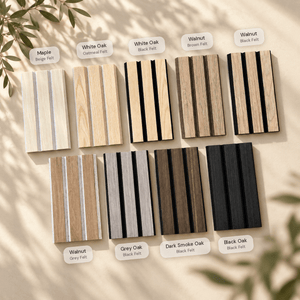



 Ultralight
 TrueWood Lite
 Solid Oak & Walnut
 Solid Bamboo
 Paint-Ready

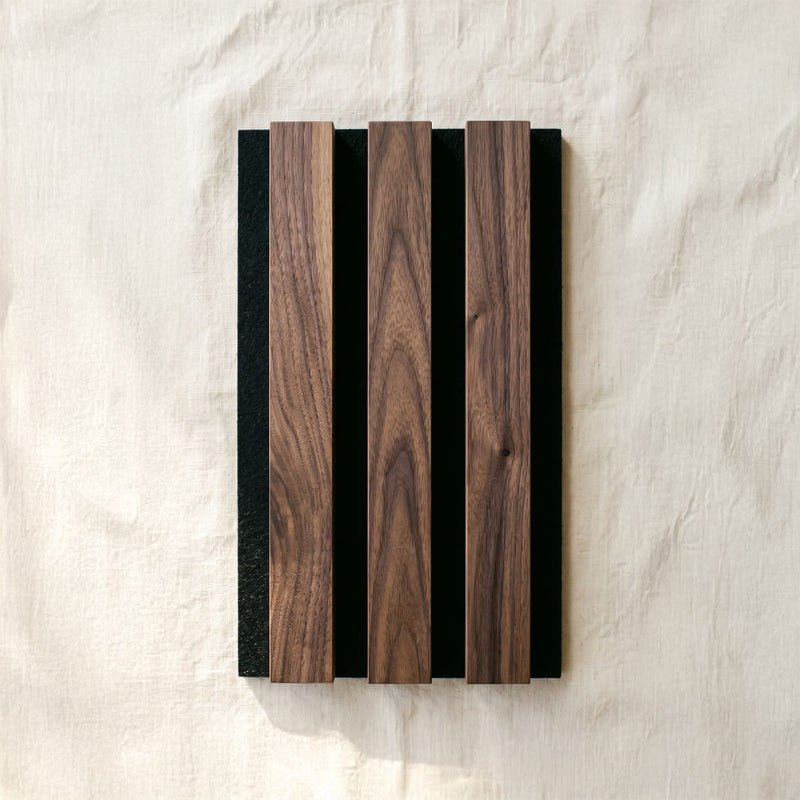

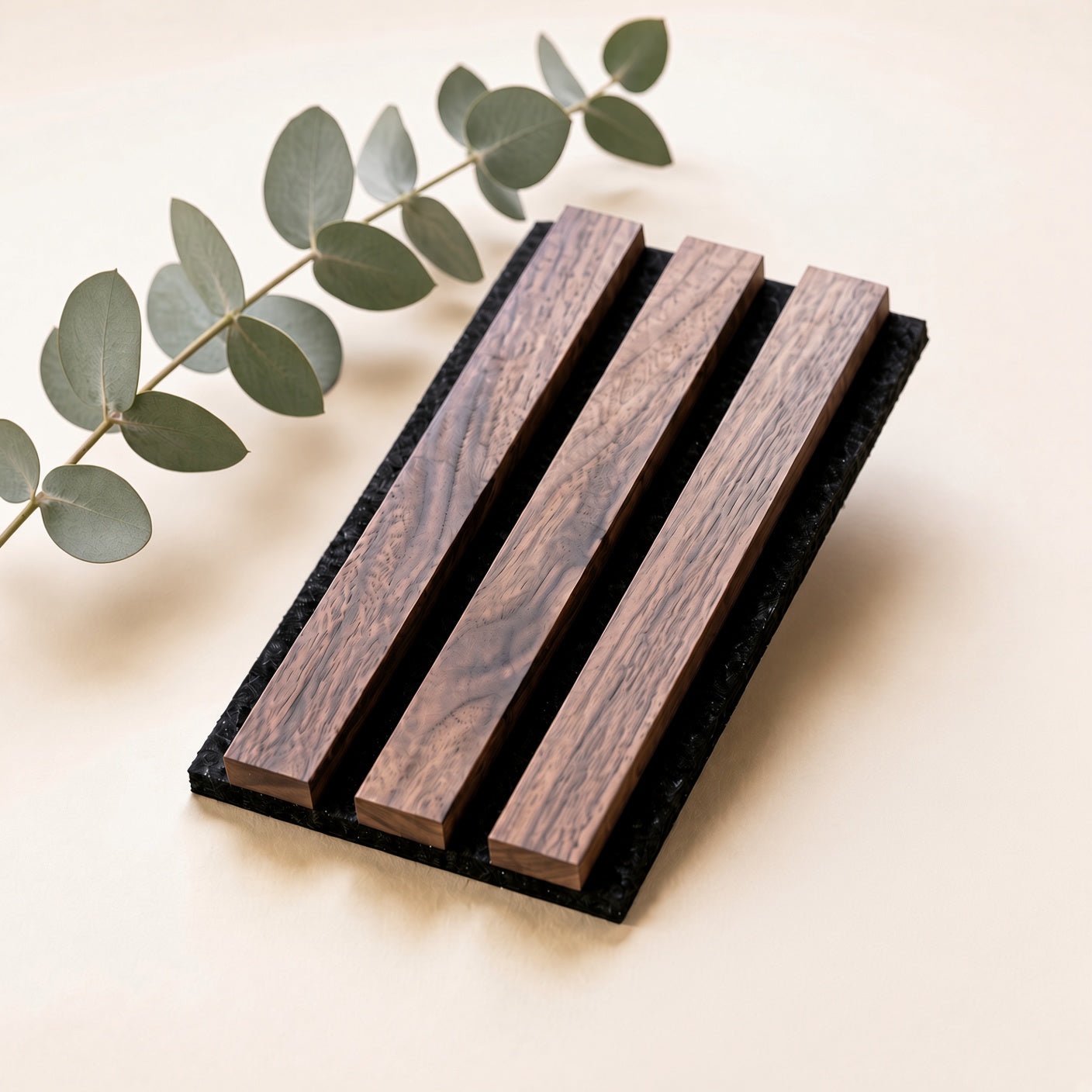
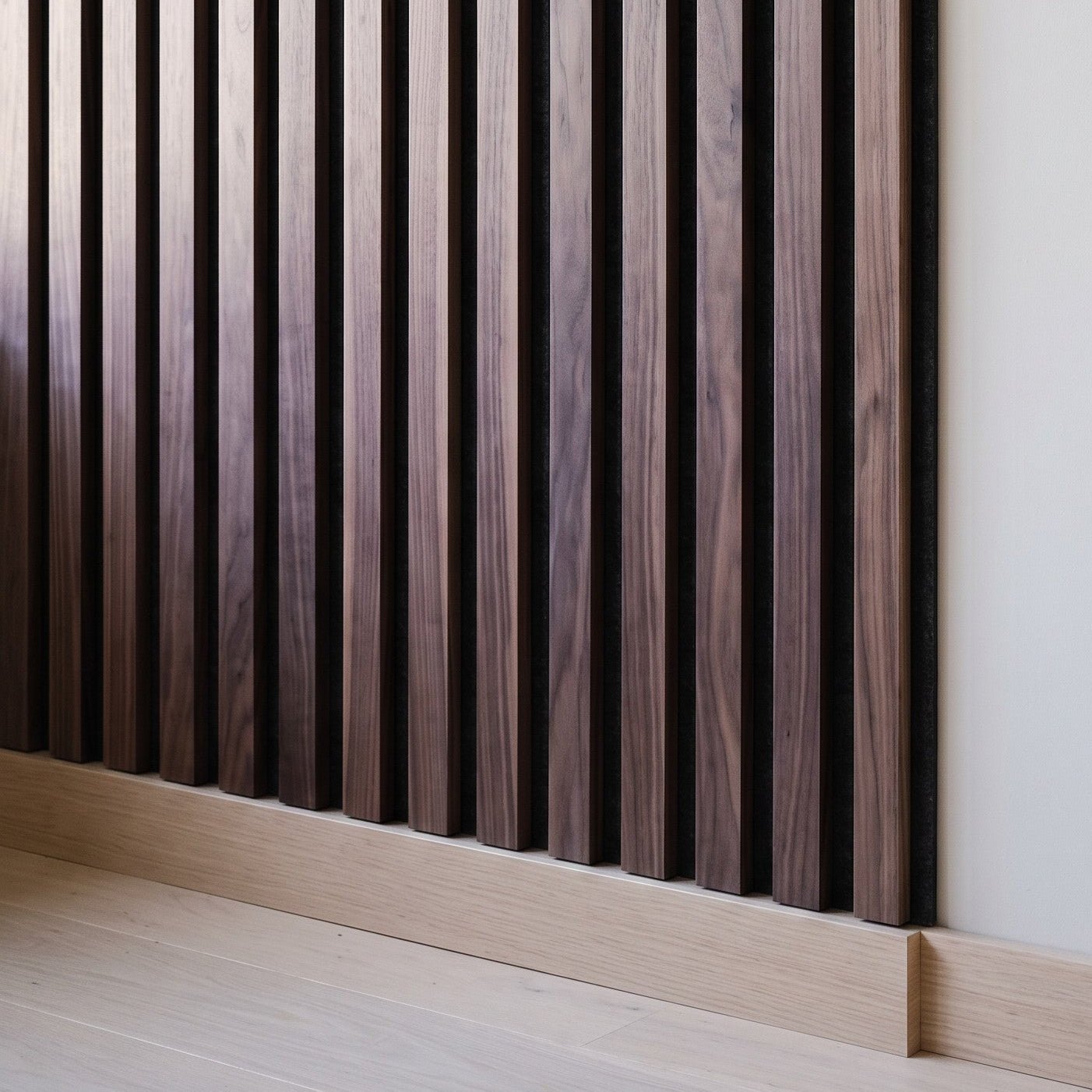
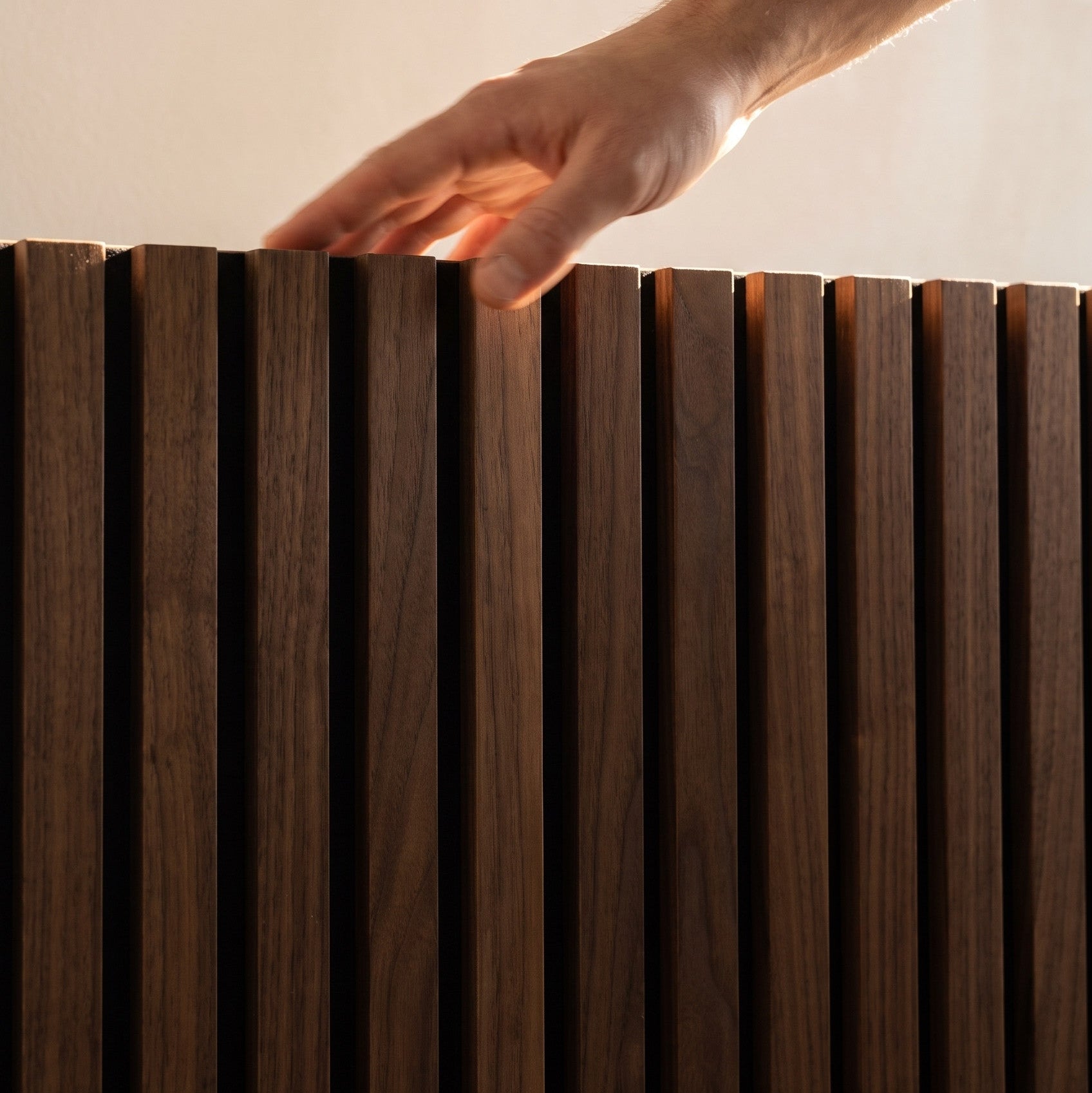
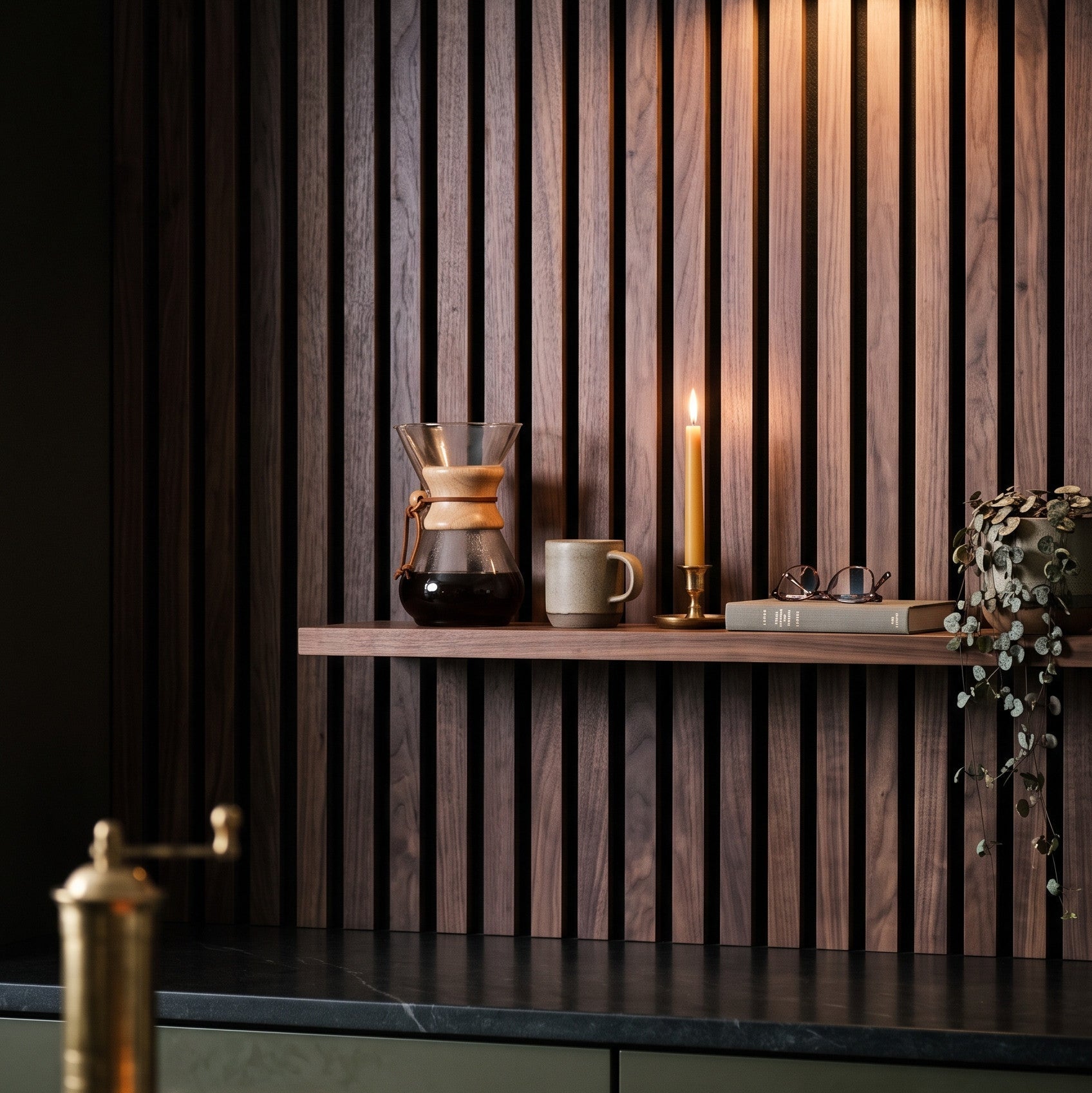
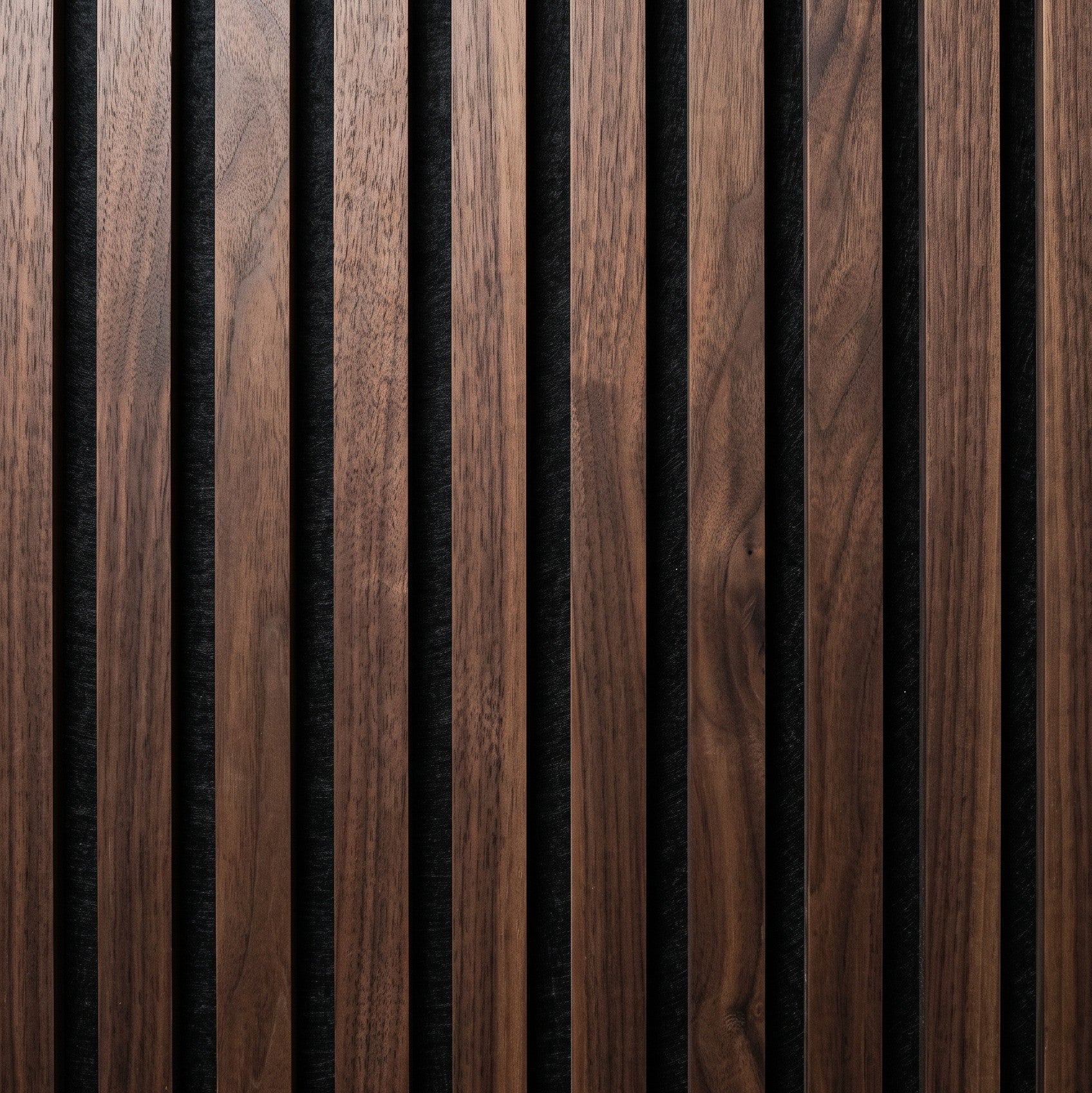
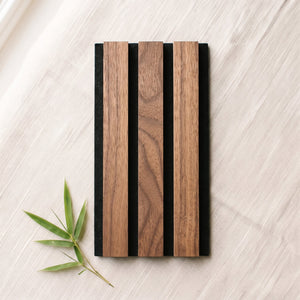
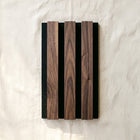
Solid Walnut Slat Panel Sample
Built for people who read the spec sheet. Every slat solid, all the way through.
- 100% Solid — no veneer, no MDF — milled front to back
- Half-inch slats on 9mm acoustic felt — real depth, real shadow
- Cut it. It’s still solid — no pale core to hide
- The top of the Slats range — walnut, oak or bamboo


In stock — Delivery soon
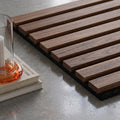
See it. Feel it. Then go all in. This is a real piece of our Solid Walnut acoustic slat panel — deep, chocolate-brown tones and genuine grain that shifts with the light. It's milled from 100% solid walnut (no veneer, no MDF, no fillers), so you get real hardwood character on every side, sealed with the same three coats of polyurethane as the full panels.
Order a sample to check the color against your floors, light, and furniture before you commit to full panels. You'll get a real solid walnut slat chip on the same black acoustic felt backing we use on the full panels — so what you see is exactly what ships.
 Features & Benefits
 Features & Benefits
Every slat is one piece of American walnut, 13mm deep. Cut it anywhere and the edge is walnut too.
Real lumber, so the figure and tone shift slat to slat. No two panels are alike.
Polyurethane that wipes clean, without the plastic shine of laminate.
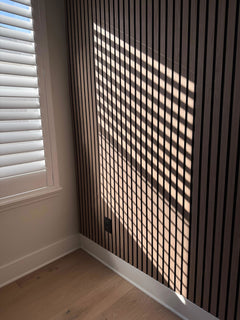
Half-inch slats cast a real shadow line that moves with the light through the day.
9mm black PET felt takes some of the hard edge off rooms with bare surfaces.
 Materials & Construction
 Materials & Construction
Solid American walnut slats27mm wide, 13mm deep, square-cut edges
Low-satin polyurethaneThree coats on the face, so it wipes clean
9mm black PET feltA rigid pressed board that keeps the slats in line
 Installation & Care
 Installation & Care
- Acclimate 48–72 hours
Unbox and lay the panels flat on the floor of the room they're going in, out of the packaging and away from direct sun and heat. Don't stand them on end.
- Lead with the lip
Each panel has a bare felt lip on one edge and an overhanging slat on the other. Face every lip the way you're working.
- Fix it
Construction adhesive, or #6 or #8 screws (1.5–2″, trim-head) through the felt in the second gap in from each edge, rows no more than 24″ apart. Or both for extra hold. Save the flattest panels for the most visible spots.
- Lap the next panel
Lower each new panel so its overhanging slat drops over the last panel's felt lip, so the gap at the join matches the gaps between slats.
- If a slat bows
Put construction adhesive behind the panel and drive a trim-head screw through the felt gap right beside the bowed slat, into a stud or solid backing. Brace it while the adhesive cures.
- Corners
Hold the panel back 13mm at an outside corner and 6.5mm at an inside corner.
You'll need
- Drill / driver (cordless is best)
- #6 or #8 screws, 1.5–2″ (trim-head for a cleaner look)
- Construction adhesive, instead of or as well as screws
- 4 ft level or a laser, and a pencil
- Tape measure
- Stud finder or wall anchors
- Track, circular or hand saw with a fine-tooth blade
- Utility knife, for felt cuts
Cutting tips
- Cut to length with a track, circular or hand saw and a fine-tooth blade. Cut to width by slicing the felt in a gap with a utility knife: whole slats come away, no saw needed.
- Run painter's tape along the cut line before you saw, so the face doesn't splinter at the edge of the cut.
- Slats are stapled to the felt from the back every 10–13″. Line your cut up to miss the staples, and re-staple any slat that comes loose.
- Don't rip a slat lengthwise. Lift off a slat instead.
- At corners, hold the panel back rather than trimming the felt lip: 13mm at an outside corner, 6.5mm at an inside corner.
- Outlets and switches: a jigsaw or multi-tool through the slats, a utility knife through the felt.
Care
- Dust as you would wood furniture
- Wipe spills with a barely damp cloth
- Skip solvent cleaners and silicone polishes, which dull the satin


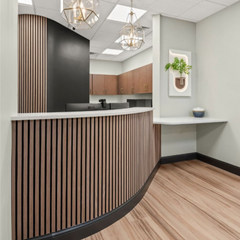
You’re in good company.
301487+ sq ft of our panels are already up in 2500+ homes & businesses across all 50 states. Join them. ★★★★★4.9 from 293 reviews
Why Solid Walnut
The real thing, all the way through
Every slat is one piece of solid American walnut, 13mm deep, on 9mm black acoustic felt. No veneer, no core.

No two slats alike
Real hardwood, real variation: cathedral grain on one slat, quiet straight grain on the next.

Cut it, it's still walnut
Trim around a switch or a door frame and the cut edge is solid walnut too. Nothing to cover.

Sealed for real rooms
Three coats of low-satin polyurethane, so splashes wipe away. Indoor use only.

Up to 141.6″ tall
Nearly 12 ft in one piece, our tallest panel, so high walls run floor to ceiling with no seam.
The details
Product specification
Specs for the full panel; your sample is a cut piece of the same build.
Every slat is one piece of solid American walnut, 13mm deep, on 9mm black PET acoustic felt. Two panels make one box: 23.62″ of wall width together. One edge carries a 15.5mm felt lip and the last slat overhangs the other by 5mm, so panels lap and every seam reads as the same 0.41″ gap as the slats.
By length
Per box of 2 panels, by the height you pick.
| 94.5″7′10″ tall | 106″8′10″ tall | 141.6″11′9½″ tall | |
|---|---|---|---|
| Coverage | 15.50 sq ft | 17.40 sq ft | 23.22 sq ft |
| Weight | 28 lbs | 31 lbs | 41 lbs |
Construction
Panel size
Box & install
FAQ
Solid Walnut questions
Pick a topic, or search all 32 answers.

Still stuck? Ask us anything about your wall. We’re real people in Garden Grove, CA, not a bot.
Sizing & boxesHow many boxes of Solid American Walnut do I need?
Each box of Solid American Walnut covers 23.62 inches (600mm) of wall width and contains two panels. Measure your wall width in inches, divide by 23.62, and round up. A 10-foot wall is 120 inches, so it takes six boxes.
Height doesn't change how many boxes you need — it only decides which panel length you order. We do recommend buying the whole wall in one order: walnut is real lumber, and boards from a later production run won't necessarily match the tone of the first.
Sizing & boxesCan I buy a single Solid American Walnut panel instead of a whole box?
Solid American Walnut is sold by the box — two panels per box, covering 23.62 inches of wall width. We don't list single panels on the site.
If your wall works out to an odd number of panels and you'd rather not buy a whole extra box for one, get in touch before you order and we'll see what we can do.
Sizing & boxesHow much does a box of Solid American Walnut weigh?
A box of Solid American Walnut holds two panels and weighs about 28 lbs at 94.5″, 31 lbs at 106″ and 41 lbs at 141.6″. Those are whole-carton weights, packaging included.
Sizing & boxesWhat are the exact specifications of Solid American Walnut panels?
Each slat of Solid American Walnut is 27mm wide and 13mm deep, milled from solid hardwood, with a 10.5mm gap beside it and eight slats to a panel. The backing is 9mm black PET acoustic felt.
A panel measures 305mm wide and covers 300mm of wall — the extra 5mm is the lap where panels overlap. Panels come in three heights: 94.5 inches, 106 inches and 141.6 inches. Each box holds two panels and covers 23.62 inches (600mm) of wall width.
The finish is three coats of polyurethane in a low satin. Indoor use only.
InstallHow do you install Solid American Walnut slat wall panels?
Solid American Walnut panels install with screws or construction adhesive, straight onto drywall or into studs.
For screws, use #6 or #8 wood screws 1.5 to 2 inches long, driven through the felt in the gap between slats. Trim-head screws have a smaller head if you'd rather not see them. Work across the wall in one direction so each panel laps over the one before it — the 5mm overlap only closes the seam if every panel goes on the same way round.
Indoor use only.
InstallDo Solid American Walnut panels need to acclimate before installing?
Yes. Let the panels sit in the room where they'll be installed before you fix anything. Solid hardwood takes on and gives up moisture depending on the air around it, and installing panels straight out of a cold delivery truck into a warm dry room is what causes joints to open up weeks later.
Lay them flat in the room, out of their packaging, for 48 to 72 hours before installing, and keep them clear of direct sun and heat sources while they settle. Don’t stand them on end against a wall while they wait: that is what makes slats bow.
It's a weekend of patience that prevents the single most common complaint about any solid wood wall.
InstallCan Solid American Walnut panels be cut to size?
Yes. Solid American Walnut panels cut like timber — a fine-tooth blade on a circular saw, track saw, jigsaw or handsaw all work. Because each slat is solid hardwood the whole way through, a trimmed edge shows the same walnut rather than exposing a pale core, so cuts look finished without an edge strip or trim to hide them.
InstallHow do I cut Solid American Walnut panels around outlets and light switches?
Measure the opening, mark it on the face of the panel and cut it out with a jigsaw before you fix the panel to the wall. Take the cut slightly wider than the electrical box so the cover plate hides the edge.
Because every slat is solid walnut all the way through, the cut edge is walnut too, so there is nothing to cover up.
InstallCan Solid American Walnut panels be installed on a curved wall, column or archway?
Partly — it depends on the curve. Solid American Walnut panels have some horizontal flex across the slats, thanks to the felt backing, so a gentle sweeping curve in a wall will work.
What they won't do is wrap a column or a tight archway. Each slat is 13mm of solid hardwood and doesn't bend along its own length, so anything with a tight radius is out.
If you're not sure whether your curve is gentle enough, send us a photo and a measurement before you order and we'll tell you straight. For columns, arches and tight radii, our Ultralight panels are built to flex and are the right choice for that.
InstallCan Solid American Walnut panels be installed on a ceiling?
Yes, with one firm rule: fix into the joists. Solid American Walnut is heavier than a veneered panel, and construction adhesive on its own is not enough overhead. Use screws into structure, with adhesive only as a supplement if you want it.
Locate your joists first and plan the panel layout so every panel catches at least two of them. Work with a second pair of hands — the longer lengths are awkward to hold overhead alone.
Everything else is the same as a wall: the same lap between panels, the same cutting, the same indoor-only rule.
InstallCan Solid American Walnut panels be installed horizontally?
Yes. Solid American Walnut panels run horizontally as well as vertically — the slats simply lie the other way.
Two things change. Your coverage math flips: a box covers 23.62 inches of wall height rather than width, so work from your wall height instead. And getting the first panel dead level matters more than usual, because a small drift is far more visible along a long horizontal run than a vertical one.
Run horizontally, our 141.6-inch panel covers just under 12 feet of wall in one unbroken length.
InstallCan Solid American Walnut panels be stacked for a wall taller than one panel?
Yes, panels can be stacked to reach a taller wall, and the join is worth planning rather than trying to hide. Butting two panels end to end leaves a horizontal line that's very hard to make invisible — and because this is solid wood, that line will move very slightly with the seasons.
Two approaches look intentional instead of accidental. Run a deliberate shadow gap, leaving a small even reveal between the upper and lower panels so the line reads as a design feature. Or break the wall with a horizontal trim piece at the transition. Both beat a butt joint fighting to disappear.
Our tallest panel is 141.6 inches — 11 feet 9.5 inches — so walls up to that height can be covered in a single run with no horizontal join at all.
InstallHow do I finish an outside corner or exposed edge with Solid American Walnut panels?
Where a run of panels ends mid-wall, the cut edge shows the ends of the slats and the edge of the felt. Because each slat is solid walnut all the way through, that edge reads as wood rather than as an exposed core — plenty of people leave it exactly as it is and it looks deliberate.
If you want a finished return, here's what we'd recommend: take a slat off one of your panels and use it as your trim. Carefully release it from the felt backing, then fix it vertically against the exposed edge to close the end of the run. Because it came out of the same batch, the color, grain and finish match exactly — which is something no bought trim piece can promise.
The same idea handles an outside corner, where a wall turns away from you: run a slat down each side of the corner so the joint is covered in matching walnut. If you'd rather have a mitered corner, cut the last slat of each run at 45 degrees so they meet cleanly — it's fiddly, so measure twice and cut a test piece first.
Plan for it when you order. Slats taken for trim come out of your coverage, so pull them from an offcut or from the last panel in a run where the loss won't show — or add a box if you have a lot of edges to finish.
InstallCan I hang a TV or shelves on Solid American Walnut panels?
You can mount lightweight items directly to Solid American Walnut panels. For anything heavy — a TV, loaded shelving — locate the studs behind the panels and fix through into the framing.
InstallWill the seam show where two Solid American Walnut panels meet?
Each Solid American Walnut panel has a 15.5mm strip of exposed felt down one edge and a slat that overhangs by 5mm on the other. The overhanging slat lays over the next panel's felt lip, so the felt butts together and the panel depth stays the same across the joint.
What you are left with is a 10.5mm gap at the seam — exactly the same gap as between the slats within a panel. The rhythm carries straight across the wall.
MaterialsAre Solid American Walnut panels solid wood all the way through?
Yes — Solid American Walnut is solid hardwood all the way through. Every slat is one piece of American walnut, 13mm (about half an inch) deep, milled from real lumber — not a thin veneer skin wrapped over a pine or MDF core. Cut a slat anywhere along its length and the cut face is walnut too.
MaterialsWhat is the difference between solid wood and MDF slat wall panels?
Many slat wall panels are built on an MDF or composite core with a thin decorative surface over it. Solid American Walnut has no core at all — each slat is a single piece of hardwood, 13mm deep, the same wood front to back.
The differences show up over time. A cut edge on solid walnut is walnut, so trimmed panels look finished instead of revealing a pale core. A scratch can be sanded out and re-finished, where a thin surface layer can't be sanded at all without going through it. And MDF swells permanently if it ever gets wet, while solid hardwood doesn't.
The honest tradeoff: MDF is very dimensionally stable and costs less. Solid hardwood costs more, carries real grain variation, and moves very slightly with the seasons. If you want a highly uniform surface at a lower price, our Solid Bamboo panels are built on exactly that idea.
MaterialsWill Solid American Walnut change color over time?
Yes, a little — and it's one of the ways you can tell it's real walnut. Unlike most hardwoods, which darken as they age, walnut lightens under UV light, easing from deep chocolate toward a warmer honey-brown. Most of that change happens in the first year and then slows right down.
Three coats of polyurethane slow it, but no finish stops it completely. If one part of a wall takes strong direct sun and another doesn't, expect that to show over time — exactly as it would on a walnut floor or table. Moving artwork and furniture around occasionally evens it out.
It isn't a fault and it isn't a finishing error. Printed and laminated surfaces don't do this at all.
MaterialsWill Solid American Walnut warp or open up gaps over time?
Solid American Walnut panels are built so that wood movement stays invisible. Each slat is only 27mm wide, so seasonal movement across a single slat is a fraction of a millimeter — and the 10.5mm gap beside it absorbs that easily. The slats sit on a PET felt backing that is dimensionally stable and keeps each slat independent, so movement never accumulates across a panel the way it would on one wide glued-up board.
Where you install them matters more than the panels do. Interior, climate-controlled rooms are what these are made for. Spaces that swing between extremes — an unheated cabin over winter, an unconditioned garage, a three-season porch — will move more than any wood wall should have to.
Laying the panels flat on the floor of the room for 48 to 72 hours before you fix them also helps, so they settle to your home's humidity before they're on the wall.
MaterialsCan a scratched Solid American Walnut slat be repaired?
Yes, and this is one of the real advantages of solid hardwood. Each slat is 13mm of walnut all the way through, so a scratch or a dent can be sanded out and the spot re-finished — the wood under the surface is the same wood as the surface. A thin veneer can't be sanded at all without going straight through the face.
For light marks, fine abrasive paper and a wipe of polyurethane is usually enough. For anything deeper, or if a slat has taken a real knock, get in touch and we'll help you sort it out.
MaterialsHow long do Solid American Walnut panels last?
Solid American Walnut is built to outlast the room it's in. There's no veneer to wear through and no composite core to swell or crumble, and because the slats are solid hardwood, a wall that's picked up scuffs after a decade can be sanded back and re-finished rather than replaced.
Treated the way you'd treat wood furniture, and kept in a normal interior environment, there's no wear-out point designed into them.
MaterialsWill Solid American Walnut panels match each other in color?
Yes — Solid American Walnut panels match. Every slat is the same American walnut, finished the same way, so a wall reads as one continuous surface rather than panels in different shades.
What does vary is the grain. Real lumber means one slat may carry sweeping cathedral figure while the next runs quiet and straight, with the gentle tonal shifts you'd see across a walnut dining table or a hardwood floor. That's the character you're buying — it's what separates solid hardwood from a printed or repeating pattern, and it's the reason no two walls look quite the same.
Two things that help: order the whole wall in one go, since boards from a later production run won't necessarily sit in exactly the same tonal range, and stand the panels up side by side before you fix anything so you can arrange them the way you like. And if a panel ever arrives looking genuinely out of step with the rest, tell us — we'll sort it out.
MaterialsDo Solid American Walnut panels absorb sound?
Solid American Walnut panels are backed with 9mm acoustic felt, which softens echo and takes the hard edge off rooms with a lot of bare surfaces — much like a rug does on a hard floor.
MaterialsAre Solid American Walnut panels fire-rated?
No. Solid American Walnut panels are not fire-rated. If fire performance is a requirement for your project, check with your contractor or your local building code before ordering.
MaterialsCan Solid American Walnut panels be painted or stained?
We wouldn't recommend painting or staining Solid American Walnut panels. Each panel carries three coats of polyurethane, so paint or stain won't take without sanding that finish back first, which removes the protection you paid for. If you want a painted slat wall, our Paint-Ready panels are primed and made for exactly that.
Shipping & careHow much does shipping cost on Solid American Walnut panels?
Shipping within the contiguous US is free on orders of $70 or more, so any 94.5″ and 106″ Solid American Walnut order ships free.
The 141.6″ panels are too long for parcel and travel by LTL freight. Four boxes or more ships free; one to three boxes has the freight rate calculated at checkout.
Shipping & careCan Solid American Walnut panels be used in a kitchen or bathroom?
Yes to both. Solid American Walnut panels carry three coats of polyurethane, which seals the wood against humidity, steam and the occasional splash — so a kitchen wall behind a dining table or across from a range works, and so does a bathroom vanity wall, a powder room, or the wall behind a freestanding tub.
What to avoid is direct, repeated water contact: inside a shower surround, along a tub splash zone, behind a sink where the wall gets wet daily. The finish handles moisture in the air and the occasional wipe-down, but these are solid hardwood, and standing water is a different problem to humidity.
Indoor use only — never outdoors.
Shipping & careHow do I clean and care for Solid American Walnut panels?
Solid American Walnut panels need very little upkeep. Dust with a soft cloth, or vacuum with a brush attachment; for anything more, a barely damp cloth is enough. Avoid solvent cleaners, abrasive pads and silicone polishes — the polyurethane doesn't need them and they'll dull the satin finish over time.
Shipping & careAre Solid American Walnut panels renter-friendly?
That depends on your lease, but yes — Solid American Walnut panels can be installed and removed. Screws leave small holes in the drywall that patch and paint like any picture hook. Construction adhesive is much harder to remove cleanly and will usually take paint and some drywall paper with it.
If you rent, use screws. When you leave, unscrew the panels, fill the holes, touch up the paint, and take the wall with you.
Shipping & careCan I take Solid American Walnut panels with me if I move?
Yes — Solid American Walnut panels can be removed and reinstalled, as long as you fixed them with screws. Unscrew the panels, patch the wall, and put them up in your next space.
Shipping & careDoes Slats.co offer Solid American Walnut samples?
Yes. The Solid Slat Panel Sample Kit is $30 and holds four samples — Solid American Oak, Solid American Walnut and both Bamboo colorways — so you can compare the species side by side in your own light.
Shipping & careWhere is Slats.co based?
Slats.co is a family-owned business based in Southern California, and all of our panels ship directly from our SoCal headquarters.
Reviews
What Solid owners say
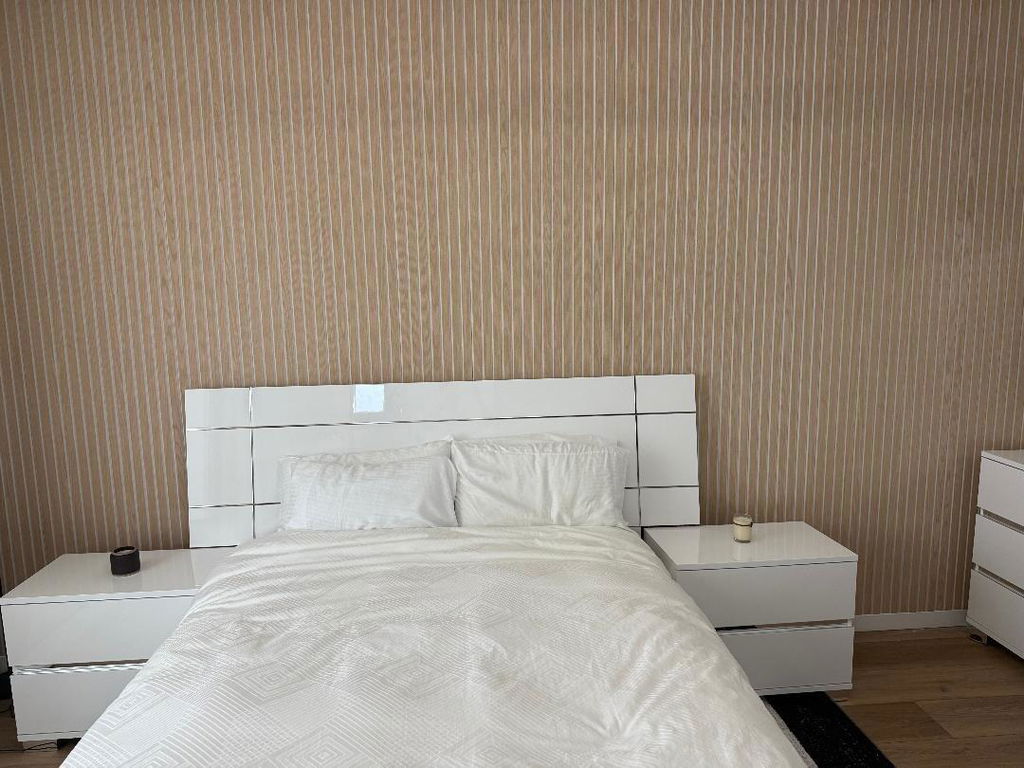
Covered the full bedroom wall with a light (oak and beige) ultralight slat. Easy to install and very pleased with the result.
I love the wood tones variation of the Dark Smoke as it looks more like real walnut. The sample seems like the Truewood Lite offers enough dimension without being bulky looking and heavy. I will order as soon as it is in stock.
The sample was beautiful very well made and I received it quickly.
loved it but it's too expensive for my project
Solid wood. Beautiful color. Well made.
This kit was invaluable in deciding what panel to buy. Simplified the process big-time.
I look at loads of these acoustic slat panels. But new when I found this company these were the best by a long stretch. Just beautiful. And customer service is incredible. Will definitely be buying from them again.
Like it very much
I ordered a sample and looks great!
We plan to install these on a ceiling. Cherrywood is not an easy color to match, but these look great. Very light material should also reduce the installers efforts.
Client services rendered as called for.
We have ordered samples from a few companies to compare colors, price and quality. So far the Slats.Co walnut tops our list.
n/a
We had an issue with one of the panels and they were really good to refund the cost of that one pannel. Great quality product. Will definitely use again
There is nothing wrong with the color. We were simply looking for something a bit browner. We were hoping this product would work because the flexibility and weight work well for our need.
TrueWood 3-Sided Veneer Acoustic Slat Panel Sample Kit
We received multiple samples of acoustic wall panels. They are high quality and a good way to see different options for our project.
Samples arrived fast but we're hard to see full design. The designs I wanted were not in stock so had to go another direction.
I like that the samples arrived quickly and most are well made but some of the wooden pieces are crooked and dont give me a great impression
Edit: The company refunded me unprompted which I appreciate. Thank you for the customer service.
ULTRALIGHT Wood Slat Acoustic Panel Sample in Walnut, Black Felt
Grey flat panel looks great for my wall design, along with Grey slat panels.
ULTRALIGHT Wood Slat Wall Panel Sample Kit
The sample kit is fantastic ... it gives you an excellent hands-on example to decide which one of the samples to use for your renovation.
High quality and value. I’ve ordered sample ls and compared 7 different manufactures. SLATS at the top for cost, quality and value.
Very happy with product and samples. High quality
Quite easy to install and we love the accent look they provided. I would recommend your product to anyone!
ULTRALIGHT Accent Wall Panel Sample in Walnut, Black Felt
Product sample pack was delivered in a timely manner and gave us a good idea of what would work for us.
Good quality but not the look we wanted
Not exactly what i was looking for.
I will order the white panels when the longer lengths are available
I like the product but, I need to know/learn how to cut it? How to handle corners and so on..
Also in walnut
Same look, other styles
Like this finish? Order a sample of it in our other styles too.