




 Ultralight
 TrueWood Lite
 Solid Oak & Walnut
 Solid Bamboo
 Paint-Ready

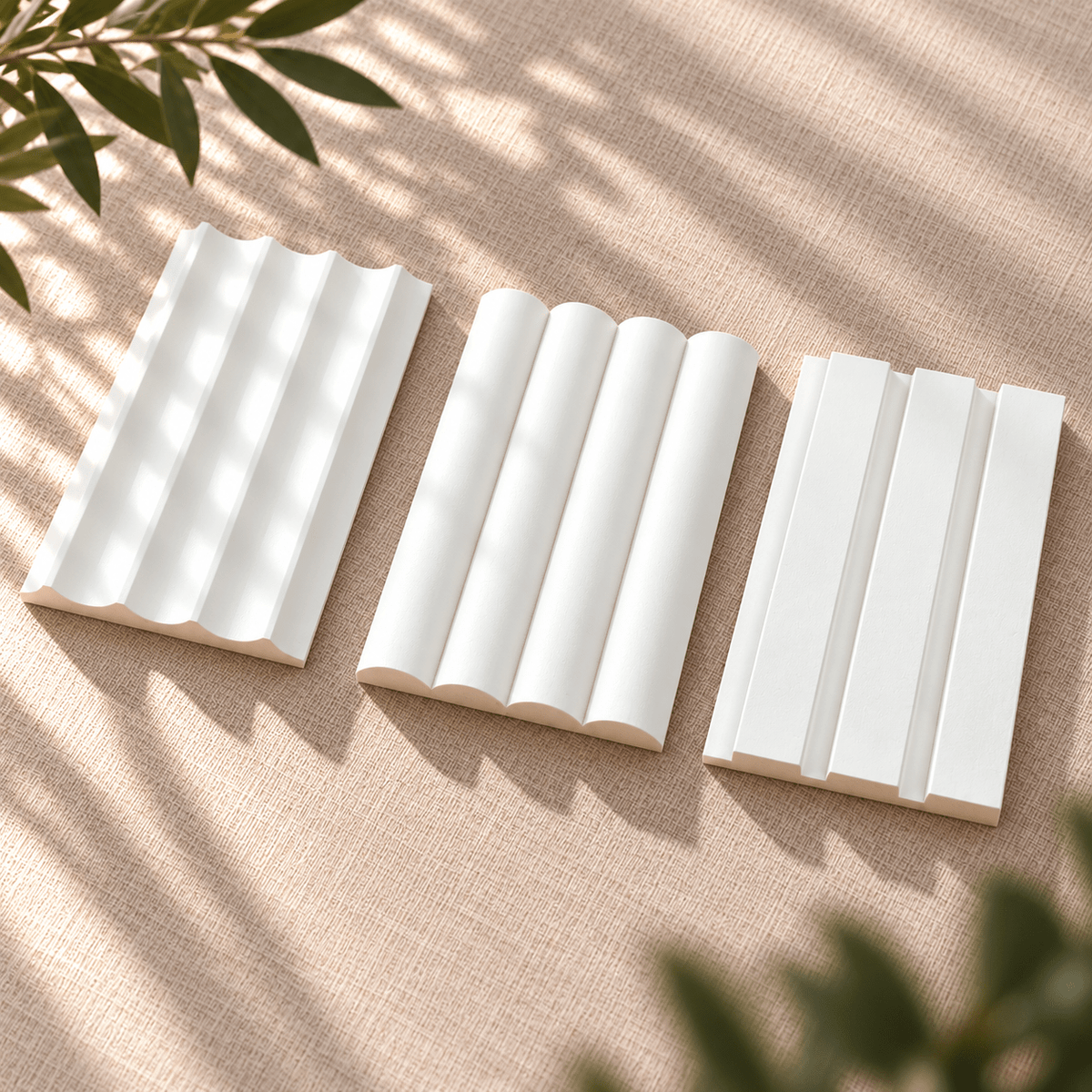
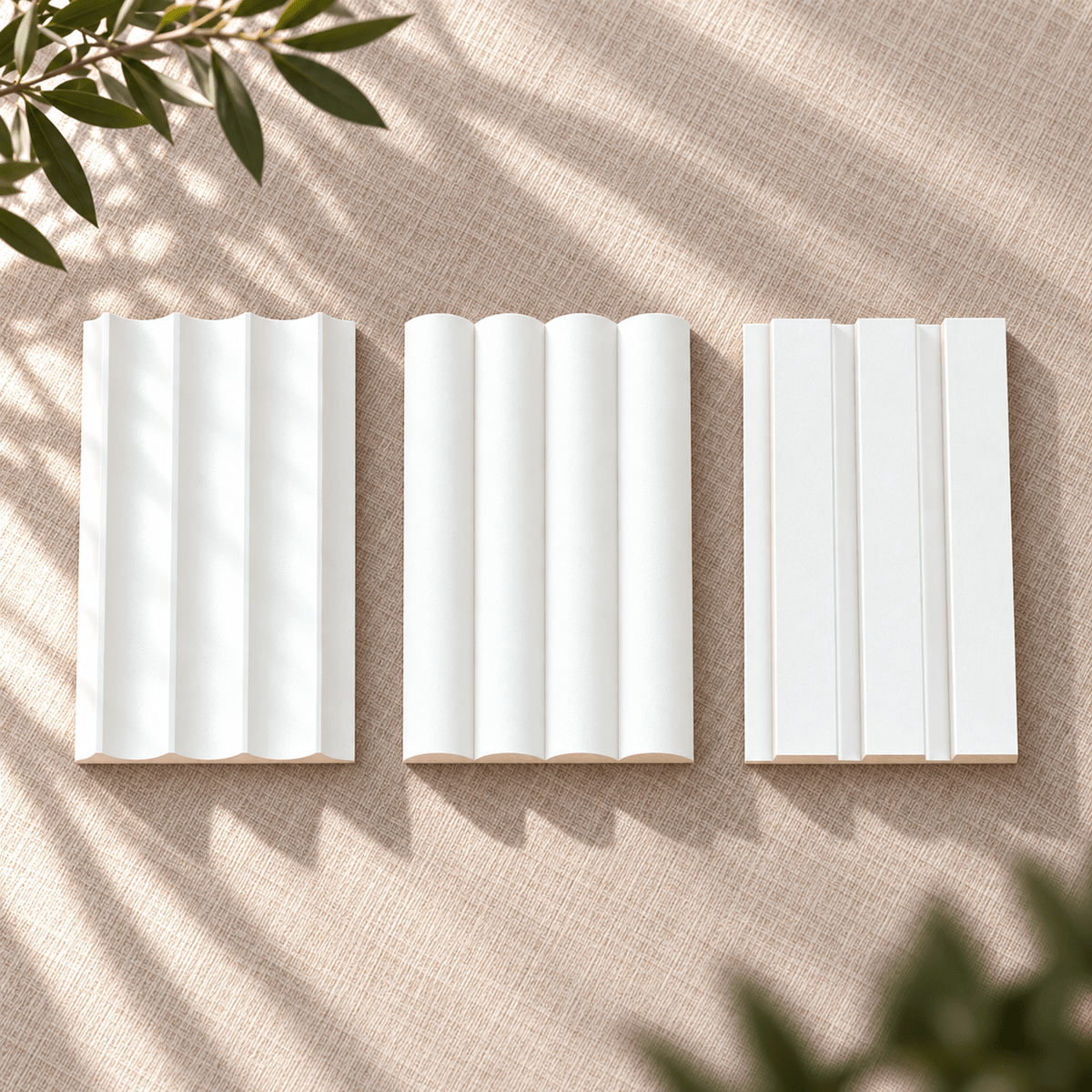
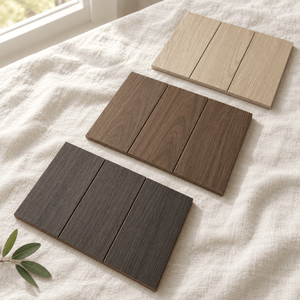
Paint-Ready Sample Kit
Primed, sanded and ready for your color — three profiles cut into one panel.
- Five coats of primer — paint straight onto it
- Three profiles — Slat, Ridge or Valley
- Bends in both directions — columns, arches, curves
- Cuts with a handsaw — no special tools
In stock — Delivery soon

Experience all three of our signature profiles—Ridge, Slat, and Valley—with this precision-crafted sample kit. Each piece is professionally primed and cut to showcase its unique character: bold convex curves, crisp 90° slat spacing, and smooth concave grooves. Whether you’re exploring profiles, testing paint finishes, or finalizing your vision, this kit gives you the clarity and confidence to design with intent.
 Features & Benefits
 Features & Benefits
Five Coats of Primer: The face arrives primed and sanded flat. Your paint goes straight onto it — no priming or sanding on the factory face. Only cut edges and filled nail holes need a touch of primer.
Paint It, Repaint It: Any colour, any sheen, and a different one in three years. The primed face takes a fresh coat without stripping anything back.
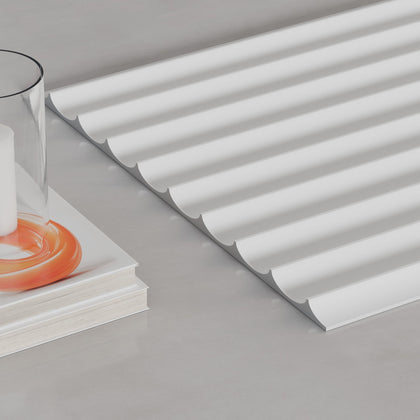
Three Profiles: Slat for a square-cut rhythm, Ridge for soft half-rounds, Valley for scooped hollows. Same panel, three very different walls.
Bends Around Curves: Deep cuts and a thin board behind them let a panel follow a column, an archway or a curved wall, in either direction.
Manageable Weight: A box of four runs 26–45 lbs depending on profile and length — Ridge is the heavy one. A single panel is easy to lift into place and brace while the adhesive grabs.
Cuts With What You Own: A handsaw, jigsaw or circular saw. No specialist blade and no training.
Butt Joints, No Gaps: Panels meet edge to edge and the seam falls where the profile already casts a shadow. On Valley, fill and sand the join before you paint.
Cut for 8ft, 9ft and 10ft Walls: 94.49″, 106″ and 118.11″ (Ridge stops at 106″), so most walls take a panel with one trim rather than a splice.
 Materials & Construction
 Materials & Construction
Each panel is MDF with the profile routed into the face, then primed — five coats, sanded flat, ready to paint.
Every profile leaves exactly 0.06″ of board beneath the deepest point of the cut, which is why the three finish at different thicknesses: Slat 0.20″, Ridge 0.35″ and Valley 0.37″. The deeper the profile, the thicker the board it starts from.
A PVC film is bonded to the back. That is what keeps a panel this thin rigid enough to handle and hang without it flexing out of shape.
Panels are 11.80″ wide and butt edge to edge, so nothing is lost at a join and four panels cover the full 47.2″ of a box.
 Installation & Care
 Installation & Care
Adhesive and a few nails. Run construction adhesive onto the back of the panel and press it to the wall. Finishing nails hold it while the adhesive sets; they go into the low point of the profile, never through a face or a peak. Set the heads just below the surface, fill and sand flush.
Straight onto the wall. Drywall, plaster or timber — there are no battens to build first.
Cutting. Any standard woodworking saw. Cut the face-side up with a handsaw or jigsaw, face-side down with a circular saw, and the face stays clean. A cut edge is raw MDF, so prime it before painting.
Painting. The face is ready as it arrives. Paint after the panels are up and the nail holes are filled. Spray gives the best result; a short-nap roller works on Slat and Ridge; on Valley, cut in with a brush first. Two thin coats beat one heavy one.
Care. Dust with a soft cloth. Once painted, wipe gently with a damp non-abrasive cloth. Repaint whenever you like — no sanding or re-priming first.


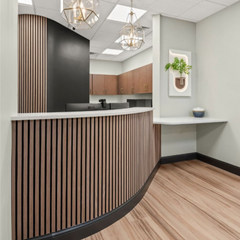
You’re in good company.
300523+ sq ft of our panels are already up in 2500+ homes & businesses across all 50 states. Join them. ★★★★★4.9 from 293 reviews
Why Paint-Ready
Ready for your color
Low-VOC MDF with the profile routed into the face and five coats of primer, sanded flat. Pick Slat, Ridge or Valley and paint it any color.

Four steps, one afternoon
Glue the back, press it up, tack it with finishing nails, then paint. Light enough to hold up on your own.

Four panels to a box
47.2″ of wall width per box. Panels butt edge to edge, so nothing is lost at a join.

Five coats of primer
Sanded flat at the factory, so your paint goes straight on. No priming, no sanding.

Cuts with a handsaw
A handsaw, jigsaw or circular saw trims a panel around a switch or a door frame.
The details
Product specification
Specs for the full panel; your sample is a cut piece of the same build.
Low-VOC MDF with the profile routed into the face, five coats of primer on the front and a PVC film on the back. Every profile leaves 0.06″ of board under the deepest cut, so deeper profiles start from a thicker board. Panels are 11.80″ wide and butt edge to edge, so four cover the full 47.2″ of a box.
By length
Per box of 4 panels, by the height you pick.
| Coverage |
| Weight |
Construction
Profile & size
Box & install
FAQ
Paint-Ready questions
Pick a topic, or search all 26 answers.

Still stuck? Ask us anything about your wall. We’re real people in Garden Grove, CA, not a bot.
Sizing & boxesHow many boxes of Paint-Ready do I need?
Measure your wall width in inches and divide by 47.2 — that is what one box of four panels covers. Round up, and order a spare box if your wall has openings to cut around. A ten-foot wall (120″) takes three boxes.
Panels butt edge to edge, so nothing is lost at the joins.
Sizing & boxesHow much does a box of Paint-Ready weigh?
A box holds four panels. Slat and Valley weigh about 26 lbs at 94.49″, 30 lbs at 106″ and 37 lbs at 118.11″. Ridge is heavier: about 35 lbs at 94.49″ and 45 lbs at 106″ (Ridge isn’t made in 118″). Those are whole-carton weights, packaging included.
Sizing & boxesWhat is the difference between Slat, Ridge and Valley?
Slat is a square-cut profile — a 1.11″ flat face beside a 0.55″ gap, cut 0.14″ deep. Ridge is a run of convex half-rounds repeating every 1.31″, cut 0.29″ deep. Valley is the inverse: a 1.18″ concave scoop with a 0.13″ flat peak between each one, cut 0.31″ deep. Slat reads as clean lines, Ridge as soft relief, Valley as deeper shadow.
Sizing & boxesAre all three profiles the same thickness?
No. Every profile leaves the same 0.06″ of board beneath the deepest point of the cut, so a deeper profile starts from a thicker board. Slat finishes at 0.20″, Ridge at 0.35″ and Valley at 0.37″.
InstallHow do I install them?
Construction adhesive on the back of the panel, pressed straight onto drywall, plaster or timber. Finishing nails hold each panel while the adhesive sets, driven into the groove or trough where the shadow hides them. No battens or subframe to build first.
InstallCan I cut the panels? How easy is it?
Yes. A handsaw, jigsaw or circular saw all work — it is MDF, not hardwood, so no specialist blade is needed. Cut face-side up with a handsaw or jigsaw and face-side down with a circular saw so any breakout lands on the back. A cut edge is raw MDF, so prime it before you paint.
InstallHow do I cut around outlets and light switches?
Mark the opening on the face, drill a starter hole inside the waste and cut it out with a jigsaw. Test-fit before the adhesive goes on. Standard outlet extenders bring the box forward to sit flush with the new face.
InstallWill the seam show where two panels meet?
Each profile is cut so the panel edge falls where a shadow already is. Ridge and Valley panels are cut at the bottom of a notch or scoop, so two half profiles close into one whole one across the join. On Slat, one panel ends on a slat’s top corner and the next begins at the groove floor, putting the seam in the shoulder line. Slat and Ridge joins need nothing more. On Valley, a continuous curve shows any step, so fill the join, sand it flush and paint over it.
InstallDoes it matter which way up the panels go?
On Slat, yes. The Slat profile isn’t symmetrical, so every panel must go up the same way round. Turn one and you either butt two slat faces together with no channel between them, or open a channel twice the width of the rest — both show instantly on a painted wall.
Ridge and Valley are symmetrical, so those panels can be turned end for end freely.
InstallCan they be installed on a ceiling?
Yes. Use construction adhesive and finishing nails as you would on a wall, and support each panel while the adhesive sets.
InstallCan they be installed horizontally?
Yes. The profile runs the length of the panel, so hanging them horizontally turns vertical fluting into horizontal banding. Plan your cuts from the same end of each panel so the pattern stays in step across the wall.
InstallCan I hang a TV or shelves on the panels?
Lightweight items can mount to the panel itself. For anything heavy, find the studs behind the panels and fix through into them — the panels are a finish, not a structural layer.
InstallHow do I finish an outside corner or an exposed edge?
Mitre the two panels where they meet, or run a slim trim down the corner and paint it the same color so it disappears. An exposed end can be filled and sanded, then painted with the rest of the wall.
InstallCan they be stacked for a taller wall?
Yes. Panels come cut for 8ft, 9ft and 10ft walls, so most rooms take a single run. For anything taller, stack a second piece and keep the horizontal join at a consistent height across the wall, where it reads as a deliberate line.
InstallDo the panels flex in both directions?
Yes. There is very little board behind the deepest part of the cut, so the panels bend horizontally and vertically — enough to wrap a column, an archway or a curved feature wall.
Paint & materialsWhat does paint-ready actually mean?
The face arrives primed — five coats, sanded flat. You paint straight onto the factory face with no priming or sanding. The only prep is filling the nail holes (and the joins on Valley) and priming any cut edge.
Paint & materialsWhat are the panels made of?
MDF, with the profile routed into the face and primer over it. A PVC film is bonded to the back, which keeps a panel this thin rigid enough to handle and hang.
Paint & materialsCan I paint them before installing?
We recommend painting after the panels are up. Nail holes need filling, Valley joins need sanding and cut edges need priming, so painting first means touching in every one of those afterwards. Spray gives the best result on all three profiles.
Paint & materialsWhat kind of paint should I use?
Any interior wall paint will take over the factory primer. Sheen decides how the profile reads: a flat or matte finish keeps the shadow and reads the profile as shape, while the higher the gloss, the more the surface reflects and the flatter the shadow looks. Go for two thin coats — heavy coats pool in the low points and soften the profile. Spray is best on all three; a short-nap roller works on Slat and Ridge; on Valley, cut in with a brush first.
Paint & materialsCan I repaint them later?
Yes, as often as you like. Clean the surface, let it dry and paint over it — no sanding back or re-priming.
Paint & materialsDo the panels absorb sound?
No. These are decorative panels with no acoustic backing. The profile breaks up a flat wall visually, but it will not change how a room sounds. For acoustic performance, look at our felt-backed slat panels instead.
Shipping & careCan I use them in a kitchen or bathroom?
Indoor, dry areas only. The face is primed MDF with no moisture protection of its own — whatever resistance the finished wall has comes from the paint you choose — so we don’t rate them for bathrooms, wet areas or outdoors. In a kitchen, keep them well away from sinks, splashbacks and anywhere they will get wet, and prime every cut edge before you paint.
Shipping & careAre the panels renter-friendly?
Not really. They go up with construction adhesive, which will take the wall surface with it when it comes off. If you may need to remove them, fix a plywood backer to the wall first and mount the panels to that.
Shipping & careDo you have samples?
Yes. A single profile is $4.99, or all three come in the Paint-Ready Sample Kit for $12.99. Worth painting a swatch before you commit a wall — color behaves differently once it is sitting in a shadow.
Shipping & careHow much does shipping cost?
Shipping is free to the contiguous U.S. on most panel orders. The exceptions are samples and 118″ panels ordered in quantities of 1–3 boxes, where shipping is calculated at checkout — order 4 or more 118″ boxes and shipping is free again. Alaska and Hawaii are calculated at checkout.
Shipping & careWhere are you based?
We’re a family-owned business based in Southern California, and all of our panels ship directly from our SoCal facility.
Reviews
What Paint-Ready owners say
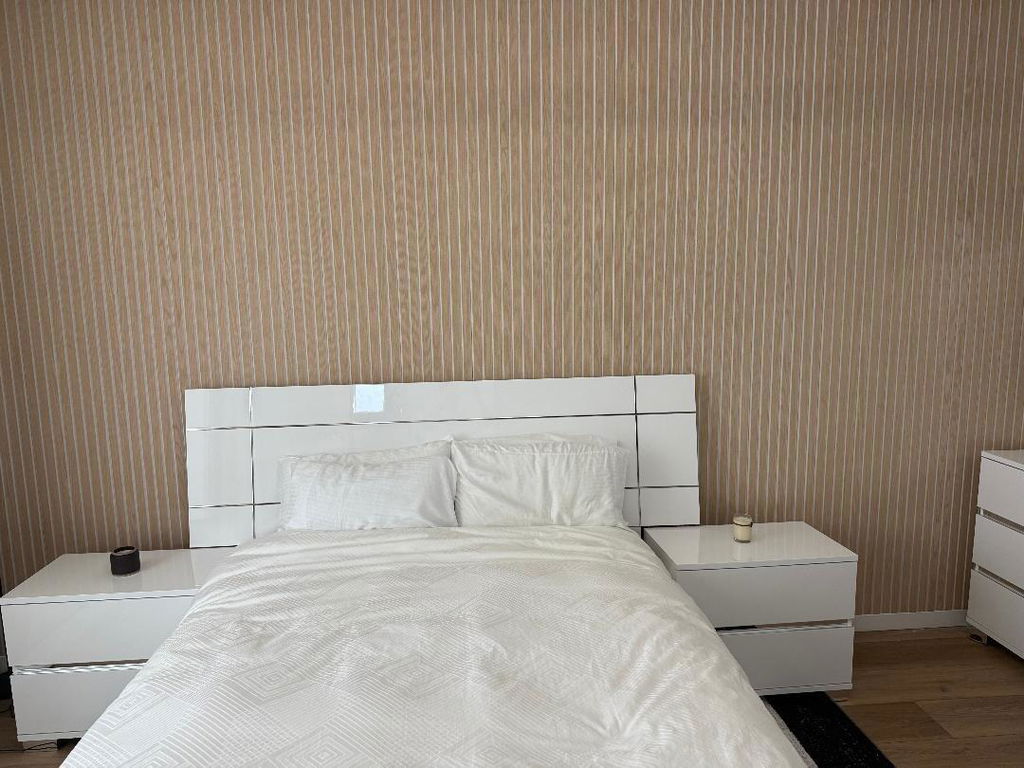
Covered the full bedroom wall with a light (oak and beige) ultralight slat. Easy to install and very pleased with the result.
The sample was beautiful very well made and I received it quickly.
loved it but it's too expensive for my project
Solid wood. Beautiful color. Well made.
This kit was invaluable in deciding what panel to buy. Simplified the process big-time.
I look at loads of these acoustic slat panels. But new when I found this company these were the best by a long stretch. Just beautiful. And customer service is incredible. Will definitely be buying from them again.
Like it very much
I ordered a sample and looks great!
We plan to install these on a ceiling. Cherrywood is not an easy color to match, but these look great. Very light material should also reduce the installers efforts.
Client services rendered as called for.
We have ordered samples from a few companies to compare colors, price and quality. So far the Slats.Co walnut tops our list.
n/a
We had an issue with one of the panels and they were really good to refund the cost of that one pannel. Great quality product. Will definitely use again
There is nothing wrong with the color. We were simply looking for something a bit browner. We were hoping this product would work because the flexibility and weight work well for our need.
TrueWood 3-Sided Veneer Acoustic Slat Panel Sample Kit
We received multiple samples of acoustic wall panels. They are high quality and a good way to see different options for our project.
Samples arrived fast but we're hard to see full design. The designs I wanted were not in stock so had to go another direction.
I like that the samples arrived quickly and most are well made but some of the wooden pieces are crooked and dont give me a great impression
Edit: The company refunded me unprompted which I appreciate. Thank you for the customer service.
ULTRALIGHT Wood Slat Acoustic Panel Sample in Walnut, Black Felt
Grey flat panel looks great for my wall design, along with Grey slat panels.
ULTRALIGHT Wood Slat Wall Panel Sample Kit
The sample kit is fantastic ... it gives you an excellent hands-on example to decide which one of the samples to use for your renovation.
High quality and value. I’ve ordered sample ls and compared 7 different manufactures. SLATS at the top for cost, quality and value.
Very happy with product and samples. High quality
Quite easy to install and we love the accent look they provided. I would recommend your product to anyone!
ULTRALIGHT Accent Wall Panel Sample in Walnut, Black Felt
Product sample pack was delivered in a timely manner and gave us a good idea of what would work for us.
Good quality but not the look we wanted
Not exactly what i was looking for.
I will order the white panels when the longer lengths are available
I like the product but, I need to know/learn how to cut it? How to handle corners and so on..
The Sample Kit is a great option to see the different colors actually in the room!
Compare the lines
Other sample kits
Weighing up more than one style? Each kit puts a line's finishes side by side in your own light.