

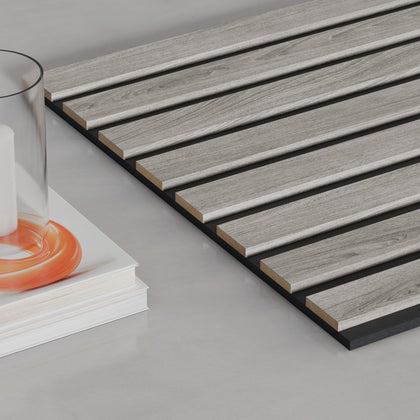

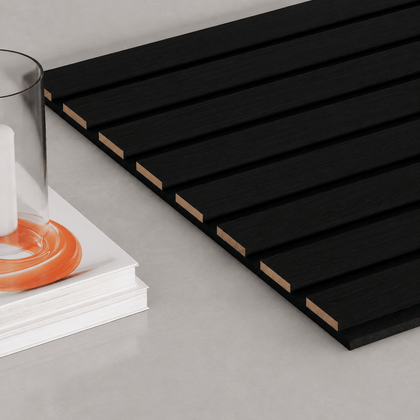



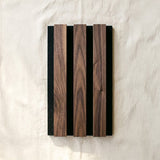

 Ultralight
 TrueWood Lite
 Solid Oak & Walnut
 Solid Bamboo
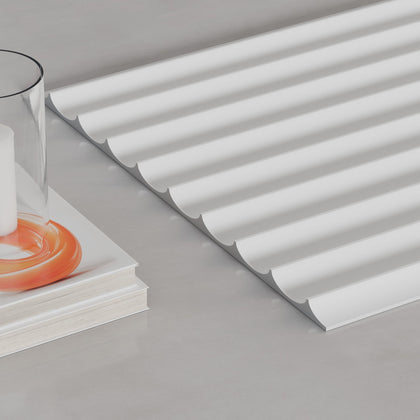
 Paint-Ready


How sound works · 7 min read
Wood slat ceilings and walls for camper vans and RVs
Why van and RV builders choose ULTRALIGHT for ceilings and walls: 9mm thin, light, flexible and soft overhead. Plus how to install it on furring strips or plywood.


Shop by color
Product lines
By ceiling height
Not sure where to start? Most people begin with samples.
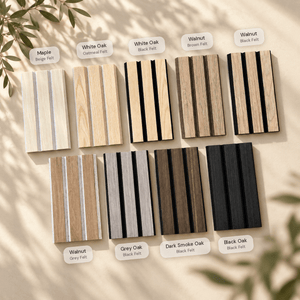
 Start hereEvery Ultralight finish9 samples · save $5.91
//Slatted · Installation
Every cut, screw, corner and outlet, for every Slats line — the way we’d do it ourselves.
The short version.
Each chapter below goes into the detail.Lay the panels out to blend the grain, draw a plumb line at your most visible corner, and work away from it so the cut panel lands at the far end. Fix each panel with screws through the felt between slats, construction adhesive, or both (ULTRALIGHT Wide and Accent are adhesive only), and butt each one tight so the join matches every other gap. Solid and TrueWood need 48 to 72 hours lying flat in the room first; ULTRALIGHT can go up the day it arrives.
In this guide32 min read
Every Slats line goes up the same basic way: plumb line, fix, butt, repeat. What changes is what’s inside the panel, and that decides how you cut it, where the screws go and what you do at a corner. Get this part right and the rest of the guide makes sense.
ULTRALIGHT is one sheet of real wood veneer laminated onto 9mm felt, with the grooves cut into it. There’s no core at all, so a sharp utility knife cuts it and it bends around a curve. TrueWood Lite is individual slats, each a solid rubberwood core wrapped in veneer on three sides, stapled to felt from behind. Solid is individual slats of solid oak or walnut, milled all the way through, also stapled from behind. Paint-Ready is primed MDF with the profile routed into the face and no felt at all.
That difference matters most in one place: because every TrueWood and Solid slat is its own piece, you can lift one off the felt and use it as trim. ULTRALIGHT and Paint-Ready can’t do that, so they handle edges differently.
Built asOne veneer sheet on 9mm felt (Slat, Wide, Accent)
Fix withSlat: screws or adhesive. Wide & Accent: adhesive only
Acclimate firstNot needed
Built asVeneered rubberwood slats, stapled to 5mm felt
Fix withScrews or adhesive
Acclimate first48–72 hours, flat
Built asSolid hardwood slats, stapled to 9mm felt
Fix withScrews or adhesive
Acclimate first48–72 hours, flat
Built asPrimed MDF, no felt
Fix withAdhesive plus finishing nails
Acclimate firstA day, flat
| Line | One box covers | Built as | Fix with | Acclimate first |
|---|---|---|---|---|
| ULTRALIGHT (Slat, Wide, Accent) | 59″ | One veneer sheet on 9mm felt | Slat: screws or adhesive. Wide & Accent: adhesive only | Not needed |
| TrueWood Lite | 47.2″ | Veneered rubberwood slats, stapled to 5mm felt | Screws or adhesive | 48–72 hours, flat |
| Solid Oak & Walnut | 23.62″ | Solid hardwood slats, stapled to 9mm felt | Screws or adhesive | 48–72 hours, flat |
| Paint-Ready | 47.2″ | Primed MDF, no felt | Adhesive plus finishing nails | A day, flat |
Start with height. Each panel is a little shorter than the wall it’s named for, which leaves room for baseboard and a ceiling that isn’t quite level: 94.49″ for an 8 ft wall, 106″ for 9 ft, 118″ for 10 ft. Solid comes in 141.6″ for 12 ft walls (and there’s no 118″ Solid, so a 10 ft Solid wall uses 141.6″ trimmed down). 141.6″ panels ship by freight, so plan for someone to be home to receive them and two people to carry each box.
Then width. Divide your wall width by what one box covers and round up. A 12 ft wall is 144″: that’s 144 ÷ 59 = 2.44, so 3 boxes of ULTRALIGHT. Rounding up leaves part of a box for cuts and offcuts; add your usual allowance on top for outlets and windows.
Hold a panel up against the wall before you trim anything. Cut panels can’t be returned, so check the length against the wall first.
Now pick your starting corner. Corners are what people look at, so start at the most visible one, inside or outside, and work away from it. The panel you have to cut then lands at the far end, ideally where the wall dies into another corner, a cabinet or a run of trim. On Solid and TrueWood, cut the last panel on the edge that meets the corner, so the factory joint edge still faces the run.
Going in a bathroom? Choose Solid Oak or Solid Walnut, sealed with three coats of polyurethane, or Paint-Ready finished in a water-resistant paint. Put them where water can’t reach them directly, and make sure the room has proper ventilation. None of our panels are waterproof, so keep them out of showers and off outdoor walls.

Open several boxes and lay the panels out before you fix a single one. Real wood varies, and no two slats are alike, so mixing panels from different boxes blends the tone and grain across the whole wall instead of leaving a patch where one box ends. Not sure about the tone? Order a sample first and hold it up in the room’s real light: veneer and felt read differently on your wall than on a screen.
Solid and TrueWood need time to settle into the room. Unbox them and lay them flat on the floor of the room they’re going into, out of their packaging, for 48 to 72 hours, clear of direct sun and heaters. If one has a slight bow, lay it high side up with a board and a few books on top while it settles. Paint-Ready wants a day lying flat in the room. ULTRALIGHT has no wood or MDF core to move, so it can go up the day it arrives.
The mistake we see most: leaning Solid or TrueWood panels on end against a wall while they wait. It feels like the tidy thing to do, and it’s how slats end up bowed. Lay them flat on the floor and give them the full 48 to 72 hours.
Finally, prep the wall. It should be clean, dry and flat. Take off outlet covers and switch plates, pull any nails or hooks, and mark the studs if you’re using screws. ULTRALIGHT and Paint-Ready follow the wall rather than straightening it, so fill or sand anything that would show through.


Construction adhesive is the better choice on masonry, concrete or brick, or anywhere you’d rather not see a fastener. Follow the adhesive maker’s cure time before you trim or hang anything off the wall.
Screws always go through the felt, never through the face of a slat. On TrueWood and Solid the felt is exposed in the gap between slats; on ULTRALIGHT Slat it’s at the bottom of each groove. Use trim-head screws: the small head sinks into the gap and all but disappears. Drive into a stud wherever one falls under a screw, and use a suitable wall anchor everywhere else.
| Line | Rows of screws | Screw | Where it goes |
|---|---|---|---|
| ULTRALIGHT Slat | ≤ 30″ apart | Trim-head | The outermost groove at each edge, about 1.7″ in. First and last rows 3″ from the ends |
| TrueWood Lite | ≤ 24″ apart | #6, 1–1.5″, trim-head | The second gap in from each edge. First and last rows 3″ from the ends |
| Solid Oak & Walnut | ≤ 24″ apart | #6 or #8, 1.5–2″, trim-head | The second gap in from each edge. First and last rows 3″ from the ends |
| ULTRALIGHT Wide & Accent | No screws | Adhesive only | A 3mm shadow reveal can’t seat a screw head. Finishing nails are fine |
| Paint-Ready | Nails | Finishing nails | The low point of the profile, never a face or a peak |
On ULTRALIGHT Slat, the groove walls sit at 45°, so a countersunk trim head beds flat and centres itself. Drive it all the way home; a bugle or pan head is too wide and sits proud. Match the screw to the felt: black screws on black felt, and on oatmeal or grey felt colour the head with a permanent marker before you drive it.

Pre-drill a small pilot hole on ULTRALIGHT for the cleanest result. On Paint-Ready, set the nail heads just below the surface, fill them and sand flush before you paint. The low point is where the shadow falls, so the filler disappears there.

Every Slats panel is cut so the join between two panels looks like every other gap on the wall. Butt each new panel tight to the last, fix it, and check plumb every two or three panels.
On ULTRALIGHT Slat, each panel end carries half a V-groove. Push the next panel in until the two 45° chamfers seat, and they close into one full groove. If the join looks wider than the others, the panel isn’t fully home. Wide and Accent meet in a deliberate 3mm shadow reveal.
On TrueWood and Solid, lower each new panel so its overhanging slat drops over the previous panel’s felt lip. Felt butts flush with felt, and the gap at the join matches the gaps across the panel.
On Paint-Ready, Slat and Ridge joins need nothing. Valley’s two half-scoops close into one continuous curve that shows any step, so fill the join, sand it flush and paint over it.
Push each ULTRALIGHT panel home until the 45° faces seat. They locate each other, so the two panels pull into line on their own.
Measure twice, and wear eye protection whenever you saw. How you cut depends on what’s inside the panel.
ULTRALIGHT Slat. A sharp utility knife and a straightedge do both cuts. Score the veneer first, then take two or three more passes through the felt. To cut to width, run the knife down the middle of a groove: the new edge is half a V, the same as a factory edge, so it butts into the next panel or a corner invisibly. Cutting a lot of panels? A saw is faster, though not cleaner: put painter’s tape along the cut line and use a fine-tooth blade with at least 60 teeth, face up.
Practise on an offcut first. It’s easy to drift off a straight line with a knife until you’ve done a couple.
ULTRALIGHT Wide and Accent. The faces are too broad for a knife alone, so take a fine-tooth blade through the veneer, face up, then a knife and straightedge through the felt. Cut Wide along a reveal wherever you can. A cut Accent edge comes out square, so send it into a corner, behind trim or against a cabinet rather than into a join mid-wall. For height, cut from the bottom so the factory edge stays at eye level.
Cutting Wide or Accent to height? Cut from the bottom, so the factory edge stays at the top, at eye level.

TrueWood Lite and Solid. Cut to length with a track saw, circular saw or handsaw and a fine-tooth blade, with a straightedge clamped on and the panel supported full length. To cut to width you don’t need a saw at all: slice the felt in a gap with a utility knife and whole slats come away clean. Only sizing the felt? A razor blade does it. Never rip a slat lengthwise on a table saw: it can be done, but it isn’t safe. Take whole slats off instead.
Before you saw TrueWood or Solid, run painter’s tape across the face and down the sides of the slats along your cut line, or the veneer will chip. Then flip the panel over: the slats are stapled to the felt every 10 to 13″, so line your cut up to miss them. If the cut takes away the staple holding a slat, put a couple of new staples in from the back so it stays put.

Paint-Ready. Cut primed MDF with a handsaw, jigsaw or circular saw: face up with a handsaw or jigsaw, face down with a circular saw, so any breakout lands on the back. When you cut to width, rip at a low point of the profile and you reproduce a factory edge that still butts cleanly to the next panel. Only 0.06″ of board sits there, so back it up and use a fine blade. Prime every cut edge before you paint.
Where cut ends go. A cut ULTRALIGHT end shows the felt edge, and a cut TrueWood end shows the rubberwood core, so plan those to land behind baseboard, at the ceiling or into a corner. Solid is wood all the way through, so a cut end looks finished.

Take the cover plate off first. Then hold the panel up in position, mark the outlet or switch on its face, and cut the opening before you fix the panel. On ULTRALIGHT, a jigsaw, a multi-tool or a sharp utility knife all work, because there’s nothing hard inside. On TrueWood and Solid, a jigsaw or multi-tool goes through the slats and a utility knife handles the felt between them. The cover plate hides the cut edges.
Switch the power off at the breaker before you work around an outlet or switch.
Check how far the panel brings the wall forward. ULTRALIGHT adds about 0.35″ and TrueWood Lite about 0.39″, so a standard cover plate usually still sits flat. Paint-Ready adds 0.20 to 0.37″ depending on profile, and most plates still sit right. Solid adds about 0.87″, so fit box extenders wherever a device now sits behind the face of the panel.
TrueWood and Solid: use your own slats. Every slat is its own piece, stapled to the felt from behind every 10–13″, so a slat lifts off cleanly and becomes trim. Same wood, same finish, nothing to colour-match.
Outside corner. Both panels present their 15.5mm felt lip, and two lifted slats butt over those lips, one slat’s end flush with the other’s face. Each slat lands 5mm on its lip and hangs 22mm past it, leaving the usual 10.5mm gap before the first slat. On Solid, hold the second panel 13mm back from the corner. TrueWood Lite is only 10mm deep, so both panels come back: 17mm on the lapped side, 12mm on the other. Glue and pin the two slats.
Inside corner. No trim needed. Lap the next panel’s overhanging slat over the first panel’s felt lip, the same joint as everywhere else on the wall. On Solid the slat reaches 22mm in, so hold that panel 6.5mm back and the two meet tight; on TrueWood Lite, hold it 5mm back. Or butt the two panels instead: on Solid, hold both 6.5mm back and leave a 13mm open square that reads as a shadow line; on TrueWood Lite nothing collides, so neither panel is held back.
Exposed edges. Run a single slat down the edge. On Solid it caps either edge, felt lip or overhanging slat. On TrueWood Lite, an edge that ends with the slat overhang is already finished; an edge that ends with the felt lip takes one slat laid flat on the lip, flush with the felt edge.
ULTRALIGHT Slat: the factory ends do the work. Every panel end is a 45° chamfer. At an inside corner, push the two panels together until the chamfers seat; they mitre themselves, with no cutting and no trim. At an outside corner, keep both factory ends and let the turning panel drop until its top sits flush with the wall face: the two chamfers line up into one clean bevel.
ULTRALIGHT Wide and Accent. At an inside corner, run one panel into the corner and butt the next square against its face. At an outside corner, cut both ends at 45° through the full 9mm and butt them: the two veneer faces meet and the mitre itself is the finished edge.
ULTRALIGHT exposed edges. At 9mm, a felt edge reads as a shadow line, so you can leave it. For a finished look, use 9mm × 2″ pine from any big-box store, glued and pinned flush with the veneer face. To match the colour, take an offcut to a paint or stain store; most will match it for free when you buy the stain.
Paint-Ready. Finish the run into a corner, a cabinet or trim, and caulk where it meets the trim before you paint.

ULTRALIGHT Slat is the panel for curved walls, columns and arches. Bend it across the slats, never along them, and work it onto the curve gradually rather than forcing it. Use adhesive, start from the tightest part of the curve, and brace it until it cures. Wide bends too, but it’s stiffer: it follows a gentle wall curve, and for a column you want standard Slat.
Solid and TrueWood are real wood, and a slat can bow slightly as it adjusts to a new room. To pull one flat, put construction adhesive behind the panel, then drive a trim-head screw through the felt gap right beside the bowed slat into a stud or solid backing. Brace it while the adhesive cures and colour the screw head with black marker. Save your flattest panels for the most visible spots.
The panels arrive with about five coats of primer, sanded flat, so the factory face needs no prep. Paint once everything is up, nail holes are filled and Valley joins are sanded. Spray gives the best result on all three profiles. Rolling works on Slat and Ridge with a short-nap roller laid off in one direction. On Valley, cut into the scoops with a brush first, because a roller bridges them. Two thin coats beat one thick one, which pools in the low points. Keep the sheen low: the flatter the finish, the more of the profile’s shadow you keep.
Paint after the panels are up, the nail holes are filled and the Valley joins are sanded. Painting first means touching in every one of those afterwards. Prime every cut edge before the first coat: bare MDF edges are where moisture gets in.

Paint-Ready going in a bathroom? Use a water-resistant paint: the paint is what protects the panel. Keep it away from direct water, in a properly ventilated room.
Dust with a soft dry cloth or a vacuum brush. Wipe up spills promptly, and skip harsh cleaners and abrasives. Don’t paint ULTRALIGHT, TrueWood or Solid: they’re real wood veneer or solid wood, finished at the factory.
Know which panel you have? Here’s the whole job for your line on one screen, with its full spec and install guide to download.
Trim-head screws, adhesive or both
Measure the wall and work out how many boxes you need. Start at the most visible corner and draw a plumb line.
Trim-head screws through the felt in the outermost groove at each edge, rows no more than 30″ apart (a bugle or pan head is too wide and sits proud). Or construction adhesive, or both.
Each end carries half a V-groove. Push until the 45° chamfers seat and the two halves close into one full groove that matches the rest. No lip, no overhang.
No rigid core, so Ultralight bends across the slats around curves and columns. Use adhesive and start from the tightest part of the curve.
Construction adhesive only
Measure the wall and work out how many boxes you need. Start at the most visible corner and draw a plumb line.
One continuous S-bead on the felt back, about 2″ in from every edge. Adhesive only: a screw head is wider than the 3mm reveal.
Each edge has a 1.5mm chamfer, so two panels close into one 3mm shadow reveal. If a join looks wider than the rest, push until the chamfers seat.
Finishing nails pin a panel while the adhesive takes. The head seats down in the reveal and disappears.
Acclimate, then adhesive, screws or both
Unbox and lay the panels flat on the floor of the room they're going in, out of the packaging and away from direct sun and heat. Don't stand them on end.
Each panel has a bare felt lip on one edge and an overhanging slat on the other. Face every lip the way you're working.
Construction adhesive, or #6 screws (1–1.5″, trim-head for the cleanest look) through the felt in the second gap in from each edge, rows no more than 24″ apart. Or both for extra hold.
Lower each new panel so its overhanging slat drops over the last panel's felt lip. The felt butts flush and the gap at the join matches the gaps between slats.
Acclimate, then adhesive, screws or both
Unbox and lay the panels flat on the floor of the room they're going in, out of the packaging and away from direct sun and heat. Don't stand them on end.
Each panel has a bare felt lip on one edge and an overhanging slat on the other. Face every lip the way you're working.
Construction adhesive, or #6 or #8 screws (1.5–2″, trim-head) through the felt in the second gap in from each edge, rows no more than 24″ apart. Or both for extra hold. Save the flattest panels for the most visible spots.
Lower each new panel so its overhanging slat drops over the last panel's felt lip, so the gap at the join matches the gaps between slats.
Put construction adhesive behind the panel and drive a trim-head screw through the felt gap right beside the bowed slat, into a stud or solid backing. Brace it while the adhesive cures.
Hold the panel back 13mm at an outside corner and 6.5mm at an inside corner.
Acclimate, then adhesive, screws or both
Unbox and lay the panels flat on the floor of the room they're going in, out of the packaging and away from direct sun and heat. Don't stand them on end.
Each panel has a bare felt lip on one edge and an overhanging slat on the other. Face every lip the way you're working.
Construction adhesive, or #6 or #8 screws (1.5–2″, trim-head) through the felt gap. Or both for extra hold. Save the flattest panels for the most visible spots.
Each panel has a 1″ felt lip on one edge; on the other, the last slat overhangs its felt by ½″. Lower each new panel so that overhang drops over the last panel's lip, and the gap at the join matches the gaps between slats.
Glue, press, nail, then paint
Give the boxes a day lying flat in the room. Measure the wall and work out how many boxes you need.
Lay the panel face-down and run one continuous S-bead down the back, about 2″ in from every edge. It goes straight onto drywall, plaster or timber, no battens.
Press it to your plumb line and brace it until the adhesive grabs. Slat profile: hang every panel the same way round, or the joins will show. Ridge and Valley can go either way.
Finishing nails into the low point of the profile, never a face or a peak. Set the heads, fill and sand flush. Fill and sand Valley joins too.
Two thin coats. Spray is best. On Valley, brush the scoops first, because a roller bridges them.
Solid and TrueWood, yes: lay them flat on the floor of the room, out of their packaging, for 48 to 72 hours, away from sun and heaters. Paint-Ready wants a day lying flat. ULTRALIGHT has no core to move, so it can go up the day it arrives.
ULTRALIGHT Slat, yes: score the veneer, then two or three passes through the felt. Wide and Accent need a fine-tooth blade through the veneer face first. TrueWood and Solid need a saw to cut to length, but you can cut them to width with a knife by slicing the felt between slats.
Switch off the power, remove the cover plate, hold the panel in place and mark the opening on its face, then cut it before fixing the panel. The cover plate hides the cut. Solid adds about 0.87″ of depth, so fit a box extender there.
On TrueWood and Solid, lift a slat off the felt and use it as trim. On ULTRALIGHT Slat, the factory ends are 45° chamfers that mitre themselves at a corner. Wide and Accent take a 45° cut through the full 9mm at an outside corner.
Yes, with the right panel and the right spot. Solid Oak and Solid Walnut are sealed with three coats of polyurethane, and Paint-Ready works once it’s finished in a water-resistant paint. Keep them away from direct water and make sure the room is properly ventilated. None of our panels are waterproof, so never inside a shower or on an outdoor wall.
Always through the felt, never through a slat: in the groove on ULTRALIGHT Slat, and in the second gap in from each edge on TrueWood and Solid. Use trim-head screws and colour the head to match the felt. ULTRALIGHT Wide and Accent are adhesive only.
A woodworker who built his first slat wall by hand, then started making panels so you don't have to. Our story →
Last updated November 2026. Questions? Ask us, a real person writes back.
Keep reading
How sound works · 7 min read
Why van and RV builders choose ULTRALIGHT for ceilings and walls: 9mm thin, light, flexible and soft overhead. Plus how to install it on furring strips or plywood.
Rooms & ideas · 2 min read
A home cinema can be the ultimate leisure space for movie lovers. However, the room's acoustics play a significant role in the overall...
Installation · 2 min read
You’ve made the decision to improve your room's acoustics and visual appeal with wood slat acoustic panels—a smart choice. However, determining where to...

